Nobody Ever Got Rich Selling Electricity
The AI buildout just became a $5.5 trillion leveraged buyout on a commodity. The fortunes were never in the plant — they're in the load.

THE NUMBER: $4.1 trillion — the borrowed slice of the AI buildout, according to JPMorgan’s own midyear math. The bank put the total capital going into data centers, chips, and power at $5.5 trillion through 2030. Of that, $4.1 trillion is debt. Loan-to-cost ratios averaging north of 85%, some deals past 90%. That is not how you finance a growth story. That is how you finance a parking garage with a signed tenant. Roughly seventy-five cents of every dollar in the most speculative buildout of our lifetimes is borrowed against assets that lose value on a three-year clock. Hold that number; we’ll come back to it.
JPMorgan spent its midyear outlook reassuring everyone the AI capex cycle is “profitable — for now.” Read the sentence twice. The reassurance is the alarm. When your bank tells you the patient is fine for now, you don’t relax, you ask what’s on the monitor. What’s on the monitor is the financing line, and the financing line says the cleanest thing anyone has said about this whole era: $4.1 trillion of the $5.5 trillion is debt.
That single fact reclassifies the entire business. Everybody keeps describing the frontier labs as venture-stage moonshots, and the valuations — a trillion dollars of equity stacked on the leaders — are priced like venture moonshots, all optionality and upside. But venture is an equity game. You raise equity precisely because the outcome is binary and you can’t service debt on a maybe. A company that funds itself with eighty cents of borrowed money on the dollar isn’t a venture deal. It’s a leveraged buyout. And the first rule of the leveraged buyout, the rule Henry Kravis built an empire on, is that you only lever a business whose cash flows are boring enough to bankrupt-proof the debt. You lever cigarettes and cookies. You lever RJR Nabisco — the deal they wrote Barbarians at the Gate about — because people buy Oreos and Winstons in a recession and the cash flow shows up like the tide. What you do not do, what no sane credit committee has ever done, is staple buyout-grade leverage onto a science project. That is what the AI buildout has quietly become: LBO debt on a moonshot. You get venture-stage business risk and private-equity financial risk welded into the same instrument.
So the question stops being “is AI real” — it’s real, we’ve never argued otherwise — and becomes the only question that matters for anyone deciding where to put a dollar: what exactly are you buying, and who gets paid first when the music slows?
You Are Electricity
Strip the romance off the product and here is what every player in this market is actually selling. The frontier lab, the fast-follower distilling it six weeks later, last year’s flagship marked down to clear — all of them are selling compute converted into tokens. Intelligence by the kilowatt. It is, in the most literal sense the metaphor will bear, electricity.
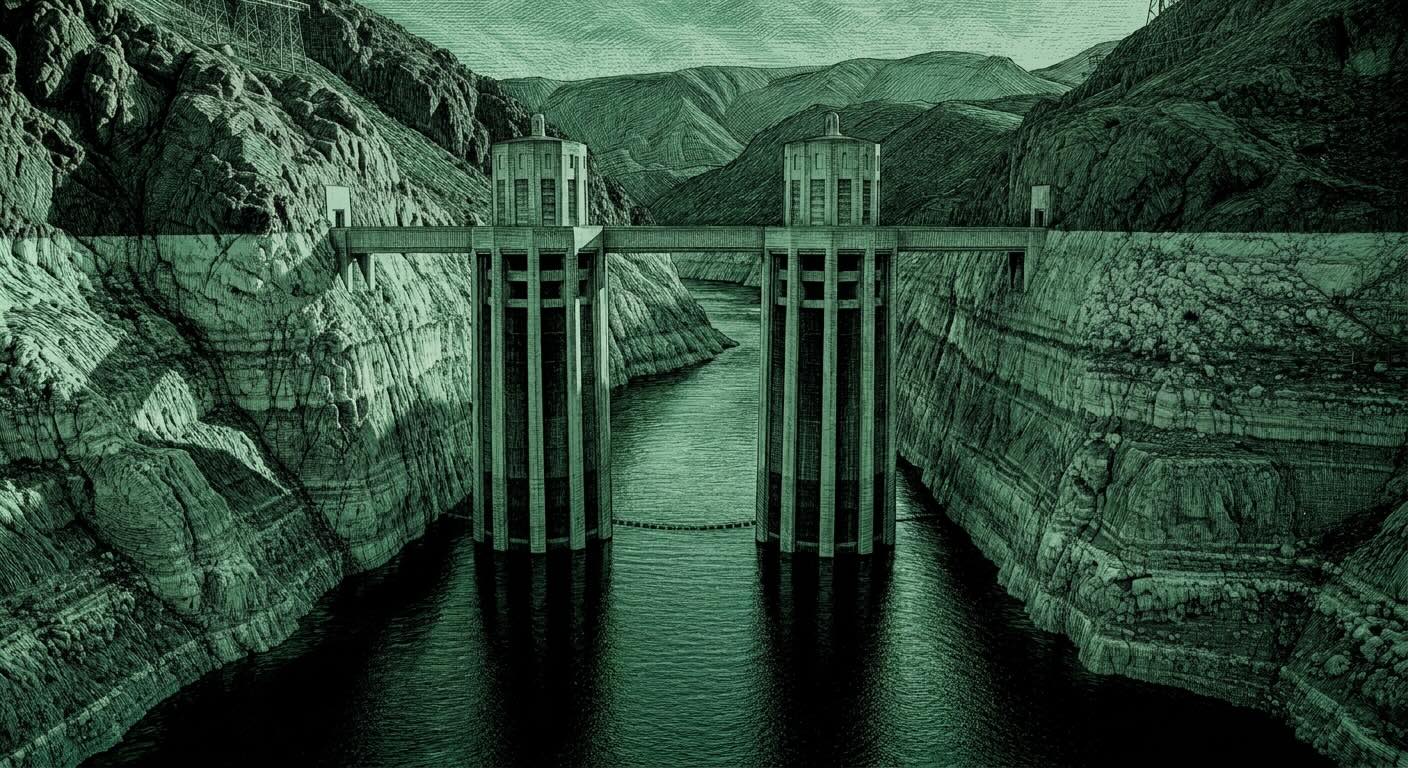
And electricity is a commodity. That doesn’t mean all producers are equal — it means they compete on cost, not on kind. Some generators sit on a hydroelectric dam or a geothermal vent and produce power for next to nothing. Some are stuck buying natural gas on the spot market at the worst possible hour. Some transmission lines are nearly lossless; some bleed current the whole way to the customer. The cost curve is everything. But a kilowatt-hour is a kilowatt-hour. Once the lights are on, no customer in the history of the grid has paid a premium to know which turbine spun. The differentiation lives entirely on the supply side, in who can make it cheapest — which is exactly the shape the model market is taking. DeepSeek’s V4 runs roughly fifty times cheaper than the American frontier on tokens alone. That’s not a feature gap. That’s a producer with a cheaper turbine.
Now the part the trillion-dollar marks have apparently never studied: nobody ever got rich generating electricity. The generators — the utilities — were the lowest-return, most capital-starved, most heavily regulated businesses of the entire twentieth century. They are the definitional widows-and-orphans stock, prized for a dividend and nothing else. The fortunes that the electrification of America actually produced went to everyone who plugged in. The aluminum smelters that needed cheap power. The factories that electrified the line. The appliance makers, the broadcasters, and eventually the entire computing economy that runs on top of the wall socket. The value of electricity was never captured by the people who made it. It was captured by the people who used it to do something nobody else could do.
That is the whole ballgame, and it cuts against the frontier bet rather than for it. “AI isn’t going anywhere” is true. It is also the bull case for the buyer of cheap intelligence, not the seller. The thing that holds its value here is the demand for the work — and that demand accrues to whoever owns the customer and can purchase a kilowatt of cognition from any generator on any given morning. We said it on June 8 in Skate to Where the Puck Is Going: the model was never the business. The grid metaphor just tells you why. The model is the turbine. The turbine is not where the money was. It never was.
The Gate Is the Tell
Watch what the leaders did this week, because cornered animals tell you where the corner is.
The same five days, OpenAI agreed to ship GPT-5.6 not to the market but customer by customer, each buyer cleared by the federal government, with Sam Altman telling his own staff in a memo that this is “not our preferred long-term model.” And Anthropic sent a letter to Congress accusing Alibaba of running roughly 25,000 fraudulent accounts to pull 28.8 million conversations out of Claude over six weeks, harvesting its most valuable capabilities — agentic reasoning, software engineering, long-horizon work — to distill into a competitor at a fraction of the cost. It is the same playbook Anthropic flagged in February against DeepSeek and Moonshot and Minimax. The remedy it’s asking for is not a better model. It’s an act of Congress: close the chip loopholes, penalize the offending labs, treat distillation as theft.
Both moves are defensive, and they rhyme. When your moat is being the smartest model on the board, and a copy six weeks behind you sells the same output for one-fiftieth the price, “smartest” has stopped paying the bills. So you do the only thing left. You wall the frontier and you call the wall security.
Here is the uncomfortable part, the part that makes this a CO/AI story and not a press release. From outside, you cannot tell whether the gate is going up for national security or for margin. Both motives point in the exact same direction — restrict access, raise the wall, keep the cheap competitor out — so the security case and the commercial case are physically indistinguishable from the cheap seats. A developer named James O’Claire wrote the quiet part plainly this week in a post called The Unbearable Cheapness of Open Weight Models: when your product is sliding toward free, you manufacture scarcity. You wrap it in luxury branding and you find a fear — China works nicely — that gets the government to restrict the competition for you. That’s the Hermès playbook, not the OpenAI one, and the labs are running it. We are not saying the distillation threat is fake; 28.8 million harvested conversations is a real wound. We’re saying the cure and the racket are wearing the same coat, and you should never let someone sell you a wall without asking whose rent it protects.
The One Way the Math Works
There is exactly one circumstance under which an electric company can safely carry eighty percent debt: a regulator guarantees it a return on its rate base. The leverage is bankable because the cash flow is legislated. The state promises the utility a fixed markup on every dollar of capital it sinks into poles and wires, and against that promise the bank lends freely. Take the guarantee away and the same leverage is a death sentence.
The labs took the utility’s leverage without the utility’s guarantee. They borrowed like regulated monopolies and they sell into a knife fight with a Chinese open-weight model that undercuts them fifty to one. The only way to make that capital structure survive is to go get the guarantee after the fact — to convince Washington to legislate the return the market refuses to provide. And that is what gating the model, banning the open-weight competitor, and reclassifying distillation as theft actually purchases. It’s not safety. It’s a synthetic rate-base guarantee, assembled one policy at a time.
Which means the trillion-dollar equity at the top of this stack is not, when you strip it down, a bet on intelligence at all. It’s a bet that the gate holds — that the regulatory capture comes through, the open weights get fenced off on national-security grounds, and the leaders get to charge frontier prices into a protected market long enough to service $4.1 trillion of debt. That’s the wager. Not “will the model be smart.” “Will the government make competing electricity illegal, and in time.” Put that way, you can see why we keep coming back to capability stopped being the moat — we wrote it on June 14, the weekend the U.S. banned its best model and China replaced it, open and cheap, by Sunday. The moat was never the silicon. The moat they’re actually building is a law.
Even the Best Seat Doesn’t Clear a Trillion
Say you don’t want to bet on the gate. You want out of the commodity, up into a higher-margin trade. There are only two doors, and we should walk through both, because the floor under each one tells you something.
Door one: compete with your own customers. Stop selling the picks and start mining the gold — build the applications, the agents, the end products, and capture the margin the model layer can’t. The labs are all edging toward it. The problem is structural and it’s old: the moment the platform competes with the developers paying its bills, it’s Daniel Plainview in There Will Be Blood, drinking the customers’ milkshake through the same straw it sold them. You can do it. You just poison the customer base that is, today, your only revenue. Ask anyone who built on top of a platform that later decided it wanted their business too.
Door two is the better one, and it’s the one the smartest money already walked through decades ago: be your own customer. Don’t sell the intelligence — apply it, in a domain where being right pays directly. This is the Jane Street move, the Citadel move, and in its purest form the Renaissance Technologies move. Jim Simons built Medallion into arguably the single greatest deployment of machine intelligence for profit in human history — something close to sixty-six percent a year, before fees, compounded for three decades. A money-printing machine of a kind the world had never seen.
And here is the fact that should reframe every trillion-dollar AI valuation on the board: Renaissance capped it. They closed Medallion to outside money, held the fund near ten billion dollars, and pushed profits back out the door every year on purpose. Why? Because edge erodes with scale. The bigger the pile of capital chasing the same inefficiency, the faster you compete away the very thing that made you rich. The greatest intelligence edge ever assembled was deliberately kept small, because its owners understood that intelligence-as-advantage doesn’t scale — it dissolves the moment you deploy it at size. Ken Griffin is worth perhaps forty or fifty billion. Citadel, the whole apparatus, is valued in the tens of billions. The most successful application of superhuman quantitative intelligence in the history of capitalism produced firms worth a fraction of what the market is currently marking a single frontier lab.
Sit with what that means. If intelligence-as-edge — the genuinely lucrative use, the print-money-in-a-secret-room use — structurally caps out in the tens of billions because the edge erodes as you scale it, and intelligence-as-utility is the low-margin commodity we already buried, then there is no version of selling smarts that arrives at a trillion dollars. The edge shrinks when you grow it. The utility was never worth much. The trillion-dollar mark requires the thing to be neither — to be a permanent, scaled, non-eroding monopoly over the world’s cognition. The only force that creates one of those is a fence the law won’t let anyone climb. We are right back at the gate. Every path leads there.
The Distiller’s Treadmill, and the Arms Dealer
What about the fast-follower — the distiller selling almost-as-good for one-fiftieth the price? Two very different animals wear that costume, and the difference is the whole geopolitical story.
The commercial distiller, the startup hoping to undercut the frontier on price, is running the Red Queen’s race from Through the Looking-Glass — sprinting flat out just to stay one step behind, never setting the price, always with another distiller forming below to do to them exactly what they did to the leader. It’s a real business. It is not a lucrative one, and it never becomes a moat, because the same cheapness that wins the customer invites the next imitator.
The strategic distiller — DeepSeek, Alibaba’s Qwen lab — is not running a business at all. For a state actor, “lucrative” is the wrong metric. Commoditizing the American frontier, draining the lead the U.S. spent hundreds of billions to build and handing it to the world for free, is the payoff. A government will happily fund a margin-negative weapon. And this is the thing the labs cannot say out loud in their letters to Congress: you cannot out-price a state actor. There is no commercial response to an opponent for whom losing money is the strategy. Which is why the response isn’t commercial. It’s the letter to Congress. The distillation suit isn’t really litigation — it’s a request for a tariff, filed because the market has no other answer.
So where, in all of this, is the seat that actually pays? Here’s a read worth sitting with, because one operator seems to have run this exact math early. Watch the shape of what Elon Musk has been building. Pull back from the frontier-chatbot war — the one that burns capital and goodwill in equal measure — and take up the two positions that survive the commoditization. First, be the arms dealer: rent the GPUs, collect the toll, stay agnostic about which model wins the war, and sit as low on the cost curve as you can by generating your own power. That’s his geothermal vent — turbines humming next to the data center while everyone else buys grid juice at spot. Second, if you train a model at all, point it at a domain with a scoreboard.
Because that’s the pattern hiding under every part of this. Intelligence converts into margin only where there’s ground truth — a verifiable result that turns the model’s output into a fact you can bank. Trading has it: did you make money, yes or no. Code has it: does it compile, do the tests pass, did it ship. A binding assay in drug discovery has it. Where there’s a scoreboard, smarts become dollars. Where there’s no scoreboard — open-ended chat, “help me think through this” — the output is unfalsifiable and the product is, once again, electricity.
But don’t mistake the scoreboard for a moat, and this is where even the smart read gets humbled. The reason code has such a clean scoreboard — verifiable, trainable, instantly monetizable — is the exact reason it’s the most crowded room in the entire industry. Every lab, every fast-follower, every startup is standing on that same scoreboard right now. The open scoreboards commoditize fastest, because the reward signal everyone can see is the reward signal everyone optimizes against. The scoreboards that stay lucrative are the secret, capital-gated, zero-sum ones — Citadel doesn’t have to worry about a competitor wandering into its game. Coding does. So a coding model is a genuine cash business, but for structural reasons it’s a cash business, not a monopoly. Money, yes. A trillion dollars, no. Which, if you listen carefully, is exactly the modest claim the savviest builders make for it — still something you can make money on. Not the future of all value. Just a business. In this market, an honest business is the contrarian position.
Own The Load
Stack it all up and look at the seats. Frontier equity at a trillion: a leveraged bet that the government fences off the competition in time to service the debt. The debt itself: capped upside on a melting asset at utility leverage with no utility guarantee — the worst risk-reward on the board. Commercial distillation: a treadmill with a thinner one forming underneath it. Strategic distillation: not a business and not for sale to you anyway. Even the best seat ever built, the Medallion seat, was capped on purpose at a rounding error next to these valuations, because the edge dissolves the moment you scale it.
Every chair at the model layer is a bad chair. That’s not a doom call on AI — the technology is the realest thing to happen to business in thirty years, and we’ve never said otherwise. It’s a doom call on the idea that you get rich by owning the generator. You don’t. You never did. Not with electricity, not with railroads, not with bandwidth, and not with this.
So don’t sit at that layer. Own the load — the customer relationship nobody can disintermediate, the proprietary data that’s yours alone, the routing table that decides which model runs which job at what price. Rent whichever electricity is cheapest and good enough this quarter, and switch the second a cheaper turbine comes online, because one will. The labs are about to spend the next few years, and four trillion dollars of other people’s money, fighting over who gets to be the utility. Let them. Own the load, not the plant. Let the labs and their bankers fight over who eats the depreciation.
— Harry and Anthony
Sources
- JPMorgan says the $5.5 trillion AI capex explosion is profitable — for now — Fortune, June 25, 2026
- OpenAI Will Initially Only Release ChatGPT 5.6 To Government-Approved Customers — Engadget, June 25, 2026
- Anthropic accuses Alibaba of large-scale distillation attack — Mobile World Live, June 25, 2026
- The Unbearable Cheapness of Open Weight Models — James O’Claire, June 25, 2026
- OpenAI just made its biggest move against Nvidia — Tom’s Guide, June 25, 2026
More like this

Mark to Market – OpenAI builds a chip. Buyers buy cheaper
A company spending $100 million on AI just told the world the frontier model is 23 times too expensive and the free one does the job. We said the model was never the moat; the market just settled the trade. Stop renting capability you can't deploy before it goes free own the judgment to know the work is right.

Memento
Google's AI out-doctored the doctors this week, and we still wouldn't let it touch us because the thing we actually trust about a doctor isn't the diploma, it's a memory we can punish. The machine wakes up a stranger every morning and bears no cost for being wrong. Stop checking the diploma. Find out who remembers, and who pays.

Central Casting
A Tokyo lab built an AI whose only job is to hire the other AIs and it outscores every one it manages. When the model is a rental, the power moves to whoever runs the casting desk. Stop standardizing on a model; own the layer that decides which one gets the part.