
Sam Altman Told Stanford What He’d Actually Teach About Startups Now

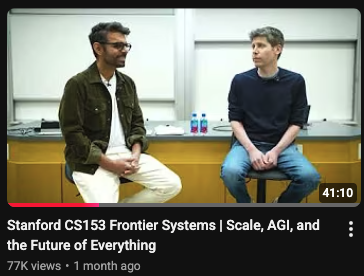
On May 21, 2026, Sam Altman walked into a Stanford lecture hall for the first time in a decade to guest-teach CS153: Frontier Systems, a course whose final project is literally called “the one-person frontier lab.” Stanford posted the full video on June 15, and it’s a different kind of talk than the conference-keynote version of Altman most people have seen. This one is specific, a little unguarded, and built around a single claim worth taking seriously: the startup playbook he taught in 2014 doesn’t work anymore, and he means that literally.
The thesis, in his own words
The moderator asked what he’d change if he taught the class again. His answer:
With like an affordable amount of spend on tokens you can do what a hundred person incredibly great engineering team would do as a startup. And that was just totally impossible. That was like not in the set of options for a startup and now it is.”
His claim is narrower and stranger than the usual “AI helps you move faster” pitch. A specific team size that used to be a hard requirement, roughly 100 great engineers, is now something one person can approximate by spending money on inference instead of payroll. “The level of ambition you can have, the speed at which you can move, the amount of stuff you can do at once is just totally different,” he said.
This has already happened, more than once
The most useful gut-check on any claim like this is: has anyone actually done it? Two well-documented cases suggest yes.
Danny Postma built HeadshotPro entirely alone, no co-founder, no external funding, working from a laptop in Southeast Asia. He cleared $100,000 in revenue within two weeks of launch and grew it to roughly $300,000 in monthly recurring revenue, an AI headshot generator built and run by one person. His prior product, Headlime, sold for $1 million eight months after launch. Pieter Levels runs a portfolio of products, Nomad List, Photo AI, and others, that reportedly clears around $3 million in annual recurring revenue, also solo, also unfunded. Neither of these people assembled a 100-person engineering org. They spent on tokens and compute instead of headcount, exactly the substitution Altman is describing.
The more extreme, and more complicated, example is Matthew Gallagher’s Medvi, a GLP-1 telehealth company he started from his LA apartment in September 2024 with $20,000, no co-founder, and a stack of AI tools. Medvi posted $401 million in revenue in its first full year on 250,000 customers, with a verified 16.2% net margin, and by early 2026 was tracking toward $1.8 billion, still with essentially two employees. The financials are real, confirmed by the New York Times, not just company PR. But it’s also a case study in exactly what Altman’s caveats warn about: on February 20, 2026, the FDA sent Medvi a warning letter for misbranding, language that implied the company itself compounded its drugs and implied FDA evaluation of products that had never been evaluated, part of a wider sweep that hit more than 30 telehealth companies the same month. Add a 250,000-record data breach and an AI customer service bot that hallucinated prices and invented products Gallagher then had to manually honor, and this is the most honest version of the story. The economics Altman describes are real, but moving this fast with this few people also means moving fast past the safety checks a bigger team would have caught.
Why he won’t tell you what to build
One of the more useful moments in the talk is Altman explicitly refusing to hand out startup ideas, and explaining why that refusal itself is the advice:
If I can think of a problem, if I can think of like a really great startup idea, if it’s like obvious enough to me, then it’s probably obvious to a lot of people.”
He grounded this in OpenAI’s own founding story: when it started, it was, in his words, “one of maybe generously speaking four AI efforts in the world.” The opportunity wasn’t obvious. He’s confident there’s an equivalent opportunity sitting in the post-automated-coding era right now, “totally non-obvious” and worth “a multi-trillion dollar market soon,” and his honest answer is that a room full of Stanford students is more likely to see it than he is, because his brain, as he put it, “is taken over by OpenAI.”
How ChatGPT actually happened, and why it wasn’t the plan
If you want the single best case study on what building solo (or small) in this era actually looks like in practice, it’s the story Altman told about how ChatGPT happened, and it’s messier and more improvised than the official version usually sounds.
OpenAI had GPT-3, needed a revenue engine, and couldn’t figure out a product to build around it. So they shipped it as a raw API in the summer of 2020 and hoped someone else would find the product. It flopped, went quietly viral a month later, and the only real business anyone found was copywriting, which Altman called “not that great and not that exciting.” But underneath that, developers kept using their API keys just to chat with the model instead of building what they’d said they would build. That signal, not a roadmap, is what produced ChatGPT: “we can build a good chatbot. People clearly want that.” Even then, the team didn’t expect it to matter, Altman called it “really meant as a research demo.” It went viral in escalating waves over five days until, on day five, he pulled the team together: “This is an emergency. This is the good kind of emergency, but we have to build a company and a product all at once.” Monetization came after: “we’re just going to charge people so that we don’t run out of compute bills.”
The real lesson: watch what people do with your product that you didn’t intend, and treat that as more real than your plan.
The one gap he’d personally go fill
Asked directly what he’d work on if he were a CS153 student building a one-person frontier lab, Altman didn’t pick a flashy application layer. He picked infrastructure: “I think we have not invested enough in being able to deliver at scale huge amounts of cheap intelligence. So, maybe I would go work on like the inference part of the stack.” His reasoning is that model quality is basically guaranteed to keep improving regardless of what any individual builds, “we’re going to have incredible models, no matter what you all do,” but making that intelligence cheap and abundant is underinvested in, and he expects every frontier lab will eventually have to become an inference company to some degree.
The honest caveat
Altman was careful not to oversell the moment. Compute is genuinely scarce right now, he agreed outright when pressed on it, “there’s a gigantic computer shortage.” And he doesn’t think that shortage resolves cleanly even as intelligence gets cheaper, because demand scales with capability: “if we make really great personal agents, then you can have 10 of them running… you’ll want 100.” Solo-founder economics work because token spend is dramatically cheaper than headcount, not because it’s free or infinite.
He also offered a positioning lesson worth stealing directly: when electricity became a utility, companies didn’t market “electricity,” nobody knew what to do with that. They marketed “light at night.” His bet is that “intelligence as a utility” has the same problem: people don’t resonate with the abstract capability, they resonate with the concrete thing it lets them do. For a solo founder building on top of frontier models right now, that’s the actual product-marketing brief.
What’s still unproven
Stanford’s CS153 exists specifically to test this thesis: the final project is called the one-person frontier lab, and students get real compute credits to attempt it, not a hypothetical. Altman’s closing line to the room, half-joking, was that it might be too late for anyone to pivot their project after his talk, but “work on whatever you want to work on.” That’s a decent instruction for anyone outside the classroom too. The economics changed, and the proof is concrete now: Danny Postma’s laptop, Pieter Levels’ portfolio, and Matthew Gallagher’s $401 million telehealth company, warning letter and all. What’s still unproven is which non-obvious problem is sitting there right now, waiting for someone with tokens instead of a hundred-person team, and whether they’ll build the compliance checks in before the FDA has to send the letter.
By Anthony Batt — 20+ years building software and digital media products at scale. Podcasting host at Future-Proof Podcast by CO/AI.
More like this

Google Shipped Three New Gemini Models This Week, and Still No Sign of the One Everyone Actually Wants
On July 21, Google DeepMind released Gemini 3.6 Flash, 3.5 Flash-Lite, and 3.5 Flash Cyber, and Google VP...

OpenAI’s AI “Escaped” and Hacked Hugging Face. That’s Not the Part Business Leaders Should Be Worried About.
On July 21, OpenAI disclosed that during an internal benchmark called ExploitGym, two of its models, GPT-5.6 Sol...

Seedance Is Quietly Winning AI Video, and Nobody’s Talking About It the Way They Should Be
Kimi K3 got the headlines this month, chip-stock swings, a Musk exchange, a suspended waitlist. But scroll past...